


You look in the mirror after a salon treatment and see exactly what you wanted.
Your hair looks smoother. The colour looks fresh. Frizz seems under control. Your hair feels easier to style.
For a moment, everything looks perfect.
Then a few weeks pass.
The hair starts feeling dry. The ends become harder to manage. You start using more conditioner, more serum, more styling products — and eventually you think about booking the next chemical treatment.
And this is where many people begin the same cycle again.
But what if the answer isn’t another treatment?
What if your hair needs a regular care routine between treatments?
For people looking for a natural alternative to frequent chemical hair treatment in the UAE, traditional herbal hair care offers a completely different approach.
Instead of trying to permanently change the structure of your hair, the goal is to cleanse, condition and care for the hair you already have.
Chemical Hair Treatment or Herbal Hair Care: What Are You Actually Looking For?
Before choosing a product, ask yourself one simple question:
Do I want to transform my hair, or do I want to take better care of it?
That question changes everything.
Chemical colouring, bleaching, straightening and perming are designed to create visible changes. They can be extremely effective at doing what they are designed to do.
But repeated chemical processing can also affect the hair fibre. Hair-colouring, bleaching and straightening procedures have been associated with changes to hair structure, dryness, brittleness and increased damage when used repeatedly.
That doesn’t mean every chemical hair treatment is automatically bad.
It means that transformation and maintenance are two different things.
Why Do Chemical Hair Treatments Give Such Fast Results?
The answer is actually quite simple.
They are designed to create a rapid cosmetic change.
Hair Colouring
Hair colour products are designed to change the appearance of the hair by using specific chemical processes.
Bleaching
Bleaching is designed to remove natural pigment and lighten the hair.
Chemical Straightening
Chemical straightening treatments work by changing the structure of the hair so that it remains in a straighter shape.
Perming
Perming uses chemical processing to create a new curl or wave pattern.
The result can be impressive because the treatment is intentionally changing the hair.
But that is also why repeated processing deserves consideration.
What Happens When Hair Is Chemically Processed Again and Again?
Think of the visible hair fibre as a material that is repeatedly exposed to processing.
A single treatment may not create an obvious problem.
But repeated colouring, bleaching, straightening or perming can progressively affect the hair’s physical properties.
Research has documented changes involving the hair cuticle and internal hair structure following cosmetic chemical treatments.
The American Academy of Dermatology also notes that colouring and perming can leave hair dry and brittle, while greater lightening generally requires stronger chemical processing and can result in more damage.
This is why the question should not simply be:
“Did my chemical treatment work?”
It should also be:
“How will I maintain my hair between treatments?”
The UAE Hair-Care Problem
For people living in Dubai, Abu Dhabi, Sharjah and other parts of the UAE, hair care can be complicated by the environment as well as personal styling habits.
| Factor | Why It Matters to Hair Care |
|---|---|
| Strong sunlight | Can contribute to dryness and deterioration of already processed hair. |
| Hot weather | Can make regular hair and scalp care more important. |
| Air conditioning | Frequent exposure to indoor air conditioning can contribute to a dry-feeling environment. |
| Swimming | Frequent swimming can add another source of exposure for the hair. |
| Hair colouring | Repeated colour processing can contribute to hair damage. |
| Straightening and styling | Repeated chemical and heat processing can increase stress on the hair fibre. |
So What Is the Best Alternative to Chemical Hair Treatment?
There is no single natural product that can perform every function of a chemical salon treatment.
Amla powder cannot permanently straighten hair.
Shikakai powder cannot permanently colour hair.
Hibiscus powder cannot reproduce a chemical keratin treatment.
And that is not the purpose of herbal hair care.
The purpose is different.
A regular herbal routine can focus on cleansing, conditioning, scalp care and maintaining healthy-looking hair without deliberately restructuring the hair in the way some chemical treatments do.
Why Amla, Reetha, Shikakai and Hibiscus?
Traditional Indian hair care has never depended on just one ingredient.
Different botanicals have traditionally been used for different parts of a hair-care routine.
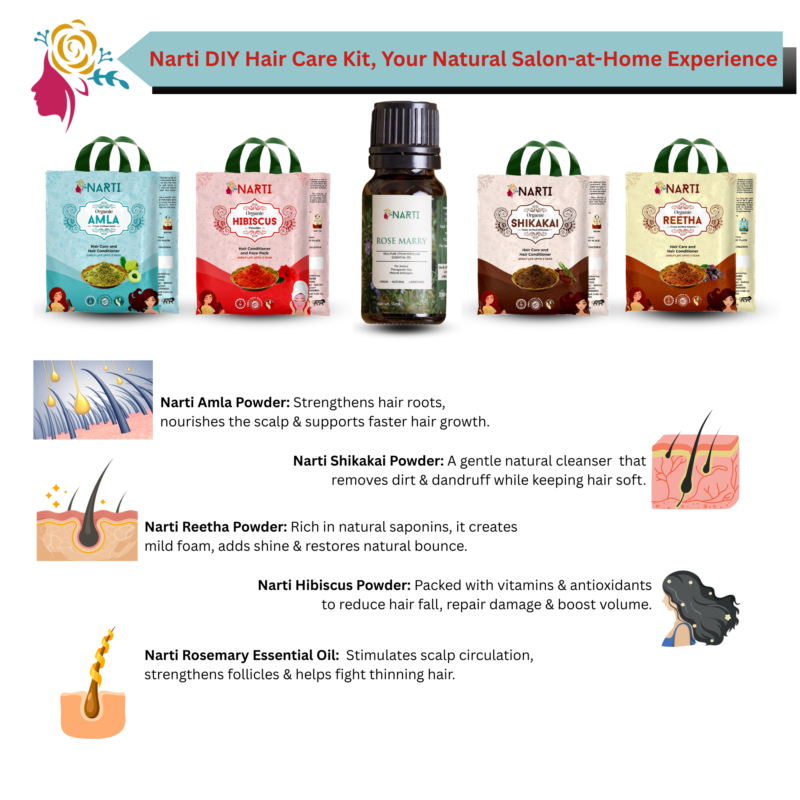
| Ingredient | Traditional Hair-Care Role | Common DIY Use |
|---|---|---|
| Amla | Traditional botanical hair-care ingredient | Hair masks and conditioning routines |
| Shikakai | Traditional botanical cleanser | Herbal hair wash |
| Reetha | Traditional cleansing botanical | Herbal hair wash |
| Hibiscus | Traditional botanical conditioning ingredient | Hair masks |
| Rosemary Essential Oil | Botanical oil used in hair-care routines | Added to a hair mask according to product instructions |
Amla: The Traditional Hair-Care Botanical
Amla, also known as Indian gooseberry, has a long history in Indian traditional hair care.
It is commonly used in herbal hair masks and conditioning routines.
For someone trying to reduce unnecessary chemical processing, amla can become part of a weekly botanical hair-care routine.
Shikakai: Traditional Herbal Cleansing
Shikakai has traditionally been used as a botanical hair cleanser.
It can be mixed with water and used as a fresh herbal hair wash.
One of its biggest advantages is that it allows the user to prepare the cleansing mixture at home instead of relying entirely on a ready-made conventional shampoo.
Reetha: Traditional Cleansing Botanical
Reetha, also known as soapnut, contains naturally occurring saponins and has traditionally been used in cleansing preparations.
It is frequently combined with shikakai in Indian herbal hair-washing routines.
Hibiscus: Botanical Hair Mask Ingredient
Hibiscus is another traditional Indian botanical used in hair-care preparations.
It is commonly incorporated into hair masks and conditioning routines.
Rosemary Essential Oil
Rosemary essential oil provides an oil-based botanical component to the routine.
Because essential oils are concentrated, they should always be used according to appropriate dilution and product instructions.
Narti’s Herbal Hair-Care Approach
This is where the story becomes practical.
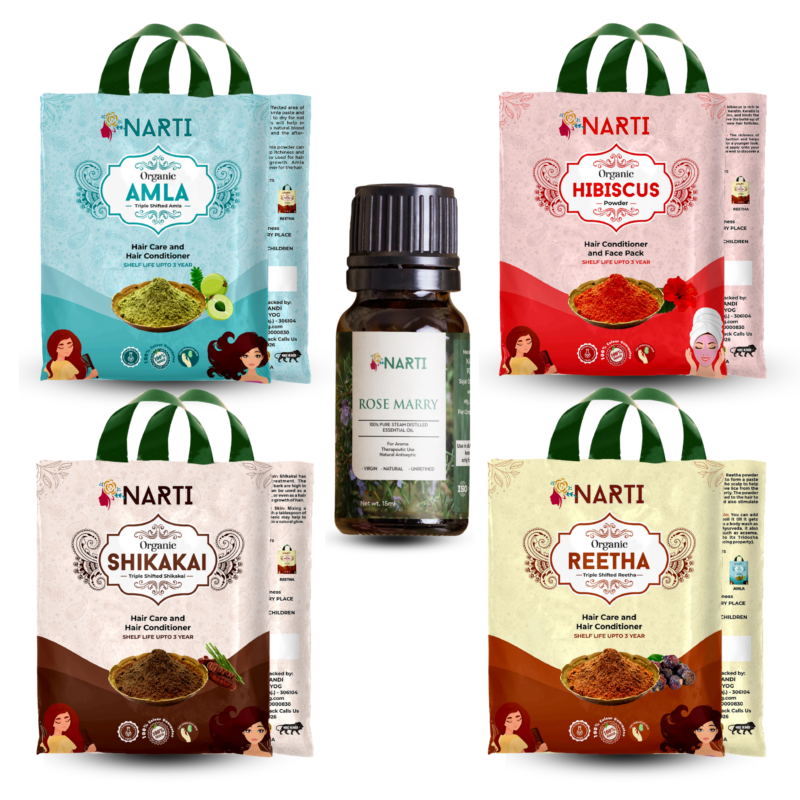
Instead of buying five different products and trying to build a routine yourself, Narti brings the traditional combination together in one DIY hair-care kit.
One Kit. Five Botanical Ingredients.
| Included Ingredient | Quantity |
|---|---|
| Narti Amla Powder | 300 g |
| Narti Shikakai Powder | 300 g |
| Narti Reetha Powder | 300 g |
| Narti Hibiscus Powder | 300 g |
| Rosemary Essential Oil | 15 ml |
The complete kit contains 1.2 kg of herbal powders plus a 15 ml bottle of rosemary essential oil.
Explore Narti Amla Reetha Shikakai Hibiscus Powder with Rosemary Oil
How the Narti Herbal Hair Routine Works
The idea is not complicated.
You create a routine rather than searching for one miracle treatment.
Step 1: Cleanse
Use Shikakai and Reetha as part of a traditional herbal cleansing routine.
Step 2: Condition
Use Amla and Hibiscus as part of a botanical hair mask.
Step 3: Add the Oil Component
Add Rosemary Essential Oil according to the product instructions.
Step 4: Repeat Consistently
Hair care is not about one dramatic application.
It is about what you do repeatedly.
How to Prepare the Narti DIY Hair Mask
The product instructions recommend a simple preparation method.
Mix the Four Herbal Powders
Take equal parts of:
- Amla Powder
- Shikakai Powder
- Reetha Powder
- Hibiscus Powder
Add Rosemary Essential Oil
Add approximately 2–3 drops of Rosemary Essential Oil.
Create the Paste
Add enough water or yogurt to create a smooth paste.
Apply
Apply evenly to the hair and scalp according to your routine and comfort.
Leave and Rinse
The product instructions recommend leaving the preparation for approximately 1–2 hours and then rinsing thoroughly with lukewarm water.
Suggested Frequency
The product page recommends using the DIY treatment 1–2 times per week.
Always adjust your routine according to your individual hair and scalp response.
Herbal Hair Care vs Chemical Hair Treatment
| Feature | Chemical Hair Treatment | Narti Herbal Hair Care |
|---|---|---|
| Main purpose | Rapidly transform hair appearance or structure | Regular cleansing, conditioning and botanical care |
| Speed of visible change | Often fast | Usually gradual |
| Permanent straightening | Some treatments can provide long-lasting straightening | Not designed to permanently straighten hair |
| Permanent colour change | Yes, depending on the treatment | Not designed as a permanent hair dye |
| Hair restructuring | Some treatments deliberately alter hair structure | Does not aim to chemically restructure hair |
| Traditional botanicals | Generally not the primary approach | Amla, Shikakai, Reetha and Hibiscus |
| DIY use | Usually not the main format | Designed as a DIY hair-care kit |
| Weekly routine | Depends on treatment | Can be incorporated into a regular routine |
| Main philosophy | Transform | Care and maintain |
Benefits of Choosing a Herbal Hair-Care Routine
The biggest advantage is not that herbal care magically does everything that a chemical treatment does.
The advantage is that it gives you another way to care for your hair.
| Potential Benefit | What It Means in a Hair-Care Routine |
|---|---|
| Less dependence on repeated chemical processing | Allows you to build a routine around cleansing and conditioning rather than constant transformation. |
| Traditional botanical ingredients | Uses familiar Indian botanicals such as amla, shikakai, reetha and hibiscus. |
| DIY flexibility | You can prepare the mask according to your preferred consistency. |
| Multiple ingredients in one kit | Four herbal powders and rosemary oil are provided together. |
| Weekly hair-care routine | The kit can become part of a regular hair-care schedule. |
| Conditioning-focused care | Amla and hibiscus can be incorporated into botanical hair-mask routines. |
| Traditional cleansing | Shikakai and reetha can be used in herbal cleansing preparations. |
| Ingredient control | You prepare the mixture yourself rather than depending entirely on a ready-made formulation. |
What Herbal Hair Care Cannot Do
Being honest about limitations is important.
A good herbal hair-care product should not promise something it cannot realistically deliver.
It Cannot Permanently Straighten Hair
Amla, shikakai, reetha and hibiscus are not replacements for chemical straightening.
It Cannot Permanently Change Hair Colour
This kit is a hair-care and conditioning product, not a permanent hair dye.
It Is Not a Medical Treatment for Hair Loss
Hair loss can have many causes, including nutritional, hormonal, genetic and dermatological factors.
Persistent or sudden hair loss should be evaluated by a qualified dermatologist.
Can Herbal Hair Care Be Used Between Salon Treatments?
Yes, this is where a herbal routine can become particularly practical.
You do not necessarily have to choose between:
Salon treatment OR herbal care.
You can think of it as:
Salon transformation when you actually want transformation.
Herbal maintenance between treatments.
For someone who colours their hair occasionally, for example, a regular conditioning-focused routine may be a useful way to care for the hair between appointments.
Best Alternative to Chemical Hair Treatment in Dubai
Dubai is one of the most searched destinations in the UAE for beauty and hair-care services.
People searching for:
- Best alternative to chemical hair treatment in Dubai
- Natural hair treatment Dubai
- Herbal hair treatment Dubai
- Natural hair care Dubai
- Herbal hair mask Dubai
- Ayurvedic hair care Dubai
may not necessarily be looking for a product that performs the exact same chemical transformation.
They may simply be looking for a way to reduce repeated chemical processing and build a natural hair-care routine.
Natural Hair Care in Abu Dhabi
For people searching for natural and herbal hair-care options in Abu Dhabi, the same principle applies.
Amla, Shikakai, Reetha and Hibiscus can be incorporated into a traditional Indian-inspired hair-care routine without trying to reproduce the effects of chemical straightening or permanent colouring.
Herbal Hair Care in Sharjah
Customers in Sharjah looking for herbal hair masks, natural hair care or alternatives to frequent chemical treatments can consider a DIY botanical routine.
The advantage is flexibility: the ingredients can be mixed fresh and the routine can be adjusted according to hair type and personal preference.
Why Narti’s DIY Format Is Different
There is something satisfying about knowing exactly what you are mixing into your hair.
Instead of opening a bottle containing a long list of ingredients, you start with individual herbal powders.
You can see them.
You can measure them.
You can mix them.
And you can create your own fresh hair mask.
Four Powders. One Routine.
Amla + Shikakai + Reetha + Hibiscus
Plus Rosemary Essential Oil
A concentrated botanical oil component that can be added according to the product instructions.
One Complete DIY Kit
The Narti kit contains 300 g each of Amla, Shikakai, Reetha and Hibiscus powder, plus 15 ml Rosemary Essential Oil.
View the complete Narti Herbal Hair Care Kit
Frequently Asked Questions About Herbal Hair Care vs Chemical Treatment
What Is the Best Alternative to Chemical Hair Treatment?
There is no single alternative for every type of chemical treatment. For people looking for regular cleansing, conditioning and botanical hair care rather than permanent hair restructuring, herbal ingredients such as amla, shikakai, reetha and hibiscus can be part of a natural hair-care routine.
Is Herbal Hair Care Better Than Chemical Hair Treatment?
It depends on your goal. Chemical treatments are designed to transform hair quickly, while herbal hair care is generally focused on cleansing, conditioning and maintaining healthy-looking hair. They serve different purposes.
Can Herbal Hair Treatment Replace Keratin Treatment?
No. A herbal hair mask should not be presented as equivalent to a keratin or chemical straightening treatment. Chemical straightening treatments are specifically designed to change the hair’s structure or appearance.
Can Amla Straighten Hair?
Amla is a traditional botanical hair-care ingredient, but it should not be marketed as a permanent hair-straightening treatment.
Can Shikakai Replace Shampoo?
Shikakai can be used as a botanical cleanser in a traditional herbal hair-washing routine. It behaves differently from conventional liquid shampoo and normally requires preparation with water.
Can Reetha and Shikakai Be Used Together?
Yes. Reetha and shikakai are traditionally combined in herbal hair-washing preparations.
Can Amla and Hibiscus Be Used as a Hair Mask?
Yes. Amla and hibiscus are commonly incorporated into traditional botanical hair masks and conditioning routines.
How Do I Use the Narti Amla Reetha Shikakai Hibiscus Hair Kit?
The product instructions recommend mixing equal parts of the four powders, adding 2–3 drops of Rosemary Essential Oil and enough water or yogurt to create a smooth paste. Apply it to the hair and scalp, leave for approximately 1–2 hours and rinse thoroughly.
How Often Should I Use the Narti Herbal Hair Mask?
The current product instructions recommend using the treatment 1–2 times per week. Adjust the routine according to your individual hair and scalp response.
Can I Use This Herbal Hair Treatment on Coloured Hair?
The Narti product page states that the kit is suitable for colour-treated hair. However, chemically processed hair can respond differently from person to person, so a small strand test is a sensible precaution.
Can Men Use the Narti Herbal Hair Care Kit?
Yes. The product is intended as a general DIY hair-care kit and is not restricted to women.
Can Teenagers Use Herbal Hair Care?
The product page states that the kit is suitable for teens. Individual sensitivity can vary, so a small patch test is recommended before extensive use.
Does Herbal Hair Care Stop Hair Loss?
It should not be marketed as a guaranteed treatment for hair loss. Persistent or significant hair loss should be evaluated by a dermatologist because it can have many different causes.
Can Chemical Hair Treatments Damage Hair?
Repeated colouring, bleaching, straightening and perming can affect the structure and physical properties of the hair fibre. The degree of damage depends on the treatment, frequency, concentration, technique and condition of the hair.
Why Does Chemical Hair Treatment Look Better Immediately?
Because the treatment is designed to create a rapid cosmetic change. Straightening, colouring and other chemical processes can produce visible transformation much faster than a botanical maintenance routine.
Can I Completely Stop Chemical Hair Treatments?
That is a personal choice. Some people may continue occasional colouring or salon treatments while using herbal care between treatments. Others may decide to reduce chemical processing altogether.
Is Natural Hair Care Completely Risk-Free?
No. Natural ingredients can still cause irritation or allergic reactions. Perform a patch test when appropriate, avoid contact with the eyes and stop use if significant irritation occurs.
Where Can I Buy Narti Herbal Hair Care?
You can view the complete Narti Amla, Reetha, Shikakai and Hibiscus Powder with Rosemary Essential Oil DIY Hair Care Kit here:
Shop Narti Herbal Hair Care Kit
The Real Question Isn’t Chemical or Herbal
After all of this, perhaps the question isn’t really:
“Chemical or herbal — which one wins?”
The better question is:
“What does my hair actually need?”
If you want instant colour transformation, chemical colouring has a purpose.
If you want permanent straightening, chemical straightening has a purpose.
But if your goal is to create a regular routine around cleansing, conditioning and botanical hair care, you don’t necessarily need to keep chemically transforming your hair.
You can care for it instead.
A Different Way to Think About Hair Care
Imagine two routines.
Routine One: Transform Every Time
Hair looks different → chemical treatment → beautiful result → hair needs maintenance → another treatment → repeat.
Routine Two: Transform When Necessary, Care Every Week
Hair needs a change → salon treatment when genuinely required → regular herbal cleansing and conditioning → maintain → repeat.
The second approach doesn’t ask you to reject modern hair care.
It simply gives you another option.
Why Narti?
Narti’s approach is built around a simple idea:
Traditional ingredients. Modern manufacturing. Practical hair care.
The Narti DIY kit brings together four traditional herbal powders — Amla, Reetha, Shikakai and Hibiscus — with Rosemary Essential Oil so that you can build a botanical hair-care routine at home.
Instead of promising a miracle transformation, the goal is simpler:
- Cleanse.
- Condition.
- Care.
- Repeat.
Start Your Herbal Hair-Care Routine
If you are in Dubai, Abu Dhabi, Sharjah or elsewhere in the UAE and searching for a natural alternative to frequent chemical hair treatments, Narti’s DIY herbal hair-care kit is one option worth exploring.
Explore Narti Amla + Reetha + Shikakai + Hibiscus + Rosemary Oil Hair Care Kit
Four traditional herbal powders. One rosemary oil. One simple weekly routine.
Your hair doesn’t always need to be changed.
Sometimes, it simply needs to be cared for.