


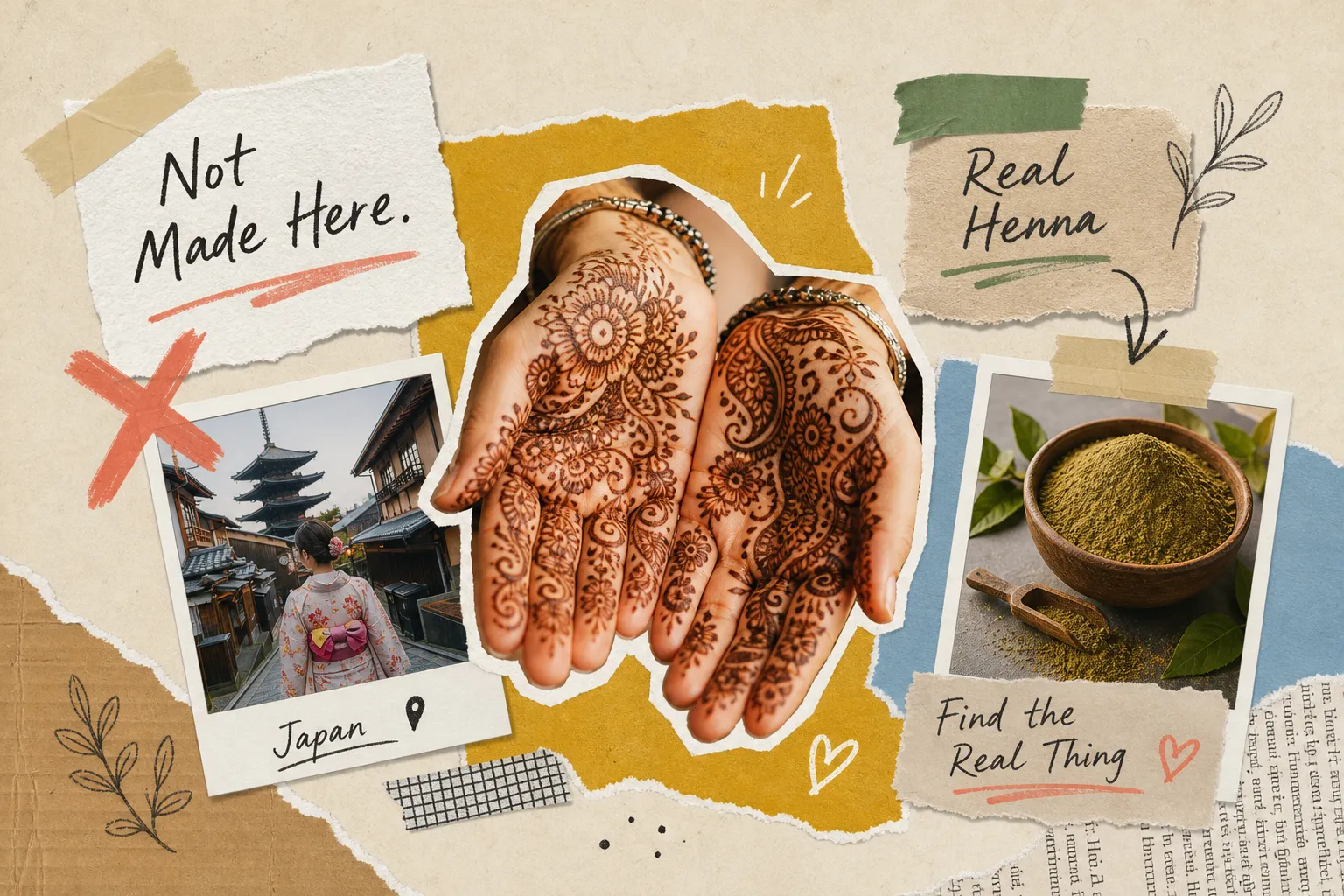
Commercial-scale henna powder production in Japan is rare: most henna available through Japanese brands is Indian in origin, sourced primarily from Rajasthan, and a handful of Japan-based businesses import, process, or repack it under Japanese branding, often at a significant retail premium. If you have been searching for henna powder that is genuinely cultivated and milled in Japan, you should know that large-scale domestic production does not exist as a commercial category. What follows explains where genuine, high-quality henna actually comes from, what makes it authentic, and how to buy it confidently without paying an import mark-up for something that was never grown in Japan to begin with. GI-certified Sojat Rajasthani henna, the raw material those Japanese brands themselves rely on, is available directly from verified Indian suppliers such as Narti Herbs.
Key takeaways
- No commercial-scale Japanese henna production: Japan has no large-scale cultivation of Lawsonia inermis, so no henna powder is manufactured there from locally grown plant material at a commercial level. Small-scale or ornamental planting has been recorded, but it does not supply any significant commercial market.
- Sojat is the real origin: GI-tagged Sojat henna from Rajasthan holds a Government of India Geographical Indication registration and is widely recognised as a benchmark for lawsone-rich, export-grade henna powder.
- Lawsone content matters most: Premium henna for hair colour and body art should carry 2.5% lawsone or higher, verified by a batch-matched COA from an accredited laboratory.
- Label terms to verify: Only 日本製 or 原産国:日本 confirm Japanese manufacture; “packaged in Japan” or a Japanese address does not.
- Buy direct from source: Purchasing GI-certified Sojat henna directly from a verified Indian supplier delivers equivalent quality at a fraction of the Japanese-branded price.
Why large-scale henna production does not exist in Japan
Lawsonia inermis is a tropical-to-arid shrub that thrives under specific growing conditions: mean annual temperatures broadly in the range of 19–27°C, well-drained sandy or stony soil, low humidity, and long dry periods that help concentrate the lawsone in the leaf and allow harvested material to be field-dried efficiently. The plant is frost-sensitive and can be harmed by temperatures below approximately 5°C. Japan’s climate works against these requirements in several ways. The country’s humid temperate zones bring cold winters, frost across most regions, and annual typhoon seasons that would waterlog and damage established henna plants. While Lawsonia inermis has been recorded as a garden or ornamental plant in warmer southern parts of Japan, there is no documented large-scale commercial planting anywhere in the country.
Without a domestic crop, there is no raw material for a Japanese factory to mill at scale. Henna powder production, which involves cleaning, drying, milling, and triple-sifting harvested leaf, depends entirely on a crop grown under the right conditions. Most commercial henna used by Japanese brands is imported, often from Sojat, Rajasthan, though small-scale domestic cultivation has been recorded and a small number of suppliers indicate Japanese processing activity. This is why searching for henna powder manufactured in Japan on a commercial scale consistently leads to a very limited market. Always verify the product’s country of origin on the label and request a lot-matched COA to confirm provenance.
Do Japan-based henna brands actually make their own powder?
Three names come up most consistently when searching for henna from Japanese suppliers. Sojat Henna by Toorabally Trading, based in Ashiya, Hyogo, explicitly names Sojat as its raw-material source, describes a process of procuring henna at the cultivation site, double-sieving it, and heat-sterilising it, and indicates some Japanese processing involvement. Green Note Co., Ltd. in Tokyo states on its own website that the henna is grown in Sojat, India. JH Natural Treatment, operating as Japan Henna Co., Ltd. in Shibuya, has been supplying the Japanese salon market since 1987, though available documentation does not clearly confirm where the leaf was cultivated or powdered. These Japan-based businesses source their raw material from Sojat and act primarily as importers, packers, or brand owners; at least one (Toorabally) indicates Japanese processing activity. Verify individual brands’ manufacturing claims on their product labels and COAs.
The label distinction matters enormously for buyers trying to make an informed purchase. A product can carry a Japanese brand name, Japanese-language packaging, and a Japanese business address without being manufactured in Japan. The only terms that reliably confirm genuine Japanese origin on a label are 日本製 (made in Japan) or 原産国:日本 (country of origin: Japan). Phrases such as “imported by,” “distributed by,” or “packaged in Japan” confirm logistics, not provenance. For practically every henna product connected to a Japanese brand, the honest answer is Indian-origin powder sold under a Japanese brand identity.
Where the world’s finest henna actually comes from
Sojat, in Rajasthan’s Pali district, accounts for the largest share of quality henna exported worldwide. The region’s combination of alkaline sandy soil, intense summer heat, and minimal annual rainfall creates growing conditions that maximise lawsone concentration in the leaf. Farmers in Sojat have cultivated Lawsonia inermis for generations, and the accumulated knowledge of harvest timing, drying technique, and milling precision is embedded in local practice in a way no other region has replicated at comparable scale. This is precisely why Japan-based henna businesses source from Sojat rather than growing their own.
Sojat henna carries a Geographical Indication registration from the Government of India, known as “Sojat Mehndi.” A GI tag functions similarly to a denomination of origin on wine: it legally ties the product name to its place of origin and prevents businesses from marketing henna from elsewhere as Sojat Mehndi. For buyers who want traceability, a GI-tagged product from a verified Sojat supplier is the strongest geographic proof available for any henna powder in the world. The GI authenticates regional identity and registered production conditions; a separate batch-specific certificate of analysis is still necessary to confirm lawsone potency and purity.
How to tell if henna powder is genuinely high quality
Lawsone (2-hydroxy-1,4-naphthoquinone) is the active dye compound in henna leaf, and its concentration directly determines staining depth, colour longevity, and performance on both hair and skin. Premium body-art-quality and hair-grade henna generally sits at 2.5% lawsone or higher, with many well-sourced Sojat batches testing near 2.8%. Any supplier worth buying from should be able to provide a recent, batch-specific certificate of analysis (COA) confirming this figure using a validated HPLC method, not just a marketing claim printed on the packet.
What a credible COA should include
A credible COA for henna powder must list the lot number, test date, botanical identity (Lawsonia inermis), lawsone percentage by dry weight, heavy-metal screening for lead, arsenic, mercury and cadmium, microbial load counts, and confirmation that no PPD (paraphenylenediamine) or synthetic dye has been added. Ask any supplier to match the COA lot number to the specific batch you are purchasing; a generic, undated “lab tested” badge is not a COA. Organic certifications such as JAS in Japan or India Organic verify farming practices, not lawsone potency, so always request both independently.
Reading the product label
Verifying the product label is the next step, and it matters more than most buyers realise. Check the manufacturer’s legal name, physical address, and country-of-origin statement. The batch number and manufacturing date should both appear on the pack. For any henna claiming Sojat GI origin, the GI certificate or authorised-user number should be available on request from the supplier. A supplier who hesitates to share this information is a clear red flag.
Where to buy authentic Rajasthani henna powder
Narti Herbs supplies GI-certified Sojat Rajasthani henna powder with 2.8% lawsone content. Narti Herbs sources its Sojat GI-certified henna directly from Rajasthan. Buying directly from a verified Indian source removes the brand premium without removing any of the quality.
Whether you choose us or another supplier, the checklist for any henna purchase is short: confirmed GI certification or verifiable Sojat origin, a batch-matched COA with lawsone percentage from an accredited laboratory, full ingredient disclosure listing only Lawsonia inermis leaf powder for pure henna, and clear manufacturer details with a physical address. The henna market has no shortage of adulterated products, and a properly issued COA is the single most effective filter against them.
What genuine henna costs compared to Japanese-branded alternatives
The price difference between buying direct and buying through a Japanese brand is significant.
Japanese-branded henna carries a noticeable premium once you add branding, packaging, import handling, and retail margins. For a buyer in India, ordering from a domestic supplier with verified Sojat GI certification and published lawsone data is straightforwardly better value than importing from Japan.
The arithmetic becomes even clearer at wholesale quantities: Indian henna exports are already the world’s primary source, available at competitive prices with shorter lead times and none of the cross-border complexity.
The honest conclusion: follow the raw material, not the label
Commercial-scale henna manufacture does not exist in Japan, and the brands that operate under a Japanese identity are themselves sourcing their raw material from Rajasthan. The three Japan-based brands covered here, namely Toorabally Trading, Green Note Co., and Japan Henna Co., source raw material from Sojat and act primarily as importers, packers, or brand owners; at least one (Toorabally) indicates Japanese processing activity. Verify individual brands’ manufacturing claims on their product labels and COAs. Their product is Indian henna with Japanese packaging, sold at a premium that reflects branding and handling costs rather than origin superiority.
The honest answer to where to find high-quality henna points straight back to Sojat. When buying, skip the geographic detour and look directly for GI-certified Sojat origin, a verified lawsone COA from an accredited laboratory, and a supplier transparent enough to share their documentation on request. That combination is what genuine quality actually looks like, regardless of which language is printed on the tin. Drop us a message at Narti Herbs to explore our range of GI-certified Sojat henna and herbal hair care products, and get the real thing at a price that makes sense.
Frequently asked questions
Where can I buy henna powder manufactured in Japan?
Large-scale commercial henna manufacturing in Japan does not exist. Most products sold by Japanese henna brands are made from Indian-origin leaf, primarily sourced from Sojat, Rajasthan, and processed or repacked in Japan. If you are searching for henna powder as a buyer in Japan or India, look for GI-certified Sojat henna from a verified Indian supplier with a batch-matched COA, rather than a Japan-manufactured product that is not available at scale.
How can I verify Sojat origin?
Ask the supplier to provide the GI certificate or authorised-user number confirming Sojat Mehndi registration. Alongside this, request a lot-matched certificate of analysis (COA) from an accredited laboratory, confirming the botanical identity as Lawsonia inermis, the lawsone percentage, heavy-metal screening results, and the absence of PPD or synthetic dyes. Match the COA lot number to the specific batch on your pack. A supplier who cannot or will not share this documentation is a red flag.
What does “buy henna powder in Japan” actually mean in practice?
If you are shopping for henna while based in Japan, your most reliable options are the established Japan-based importers such as Toorabally Trading (Sojat Henna), Green Note Co., and Japan Henna Co. All three source from Sojat. Always check the country-of-origin statement on the label: only 日本製 or 原産国:日本 confirm Japanese manufacture, and for henna this is uncommon at a commercial level. Buying from a direct Indian supplier online may offer better value, but factor in international shipping costs and customs duties.