


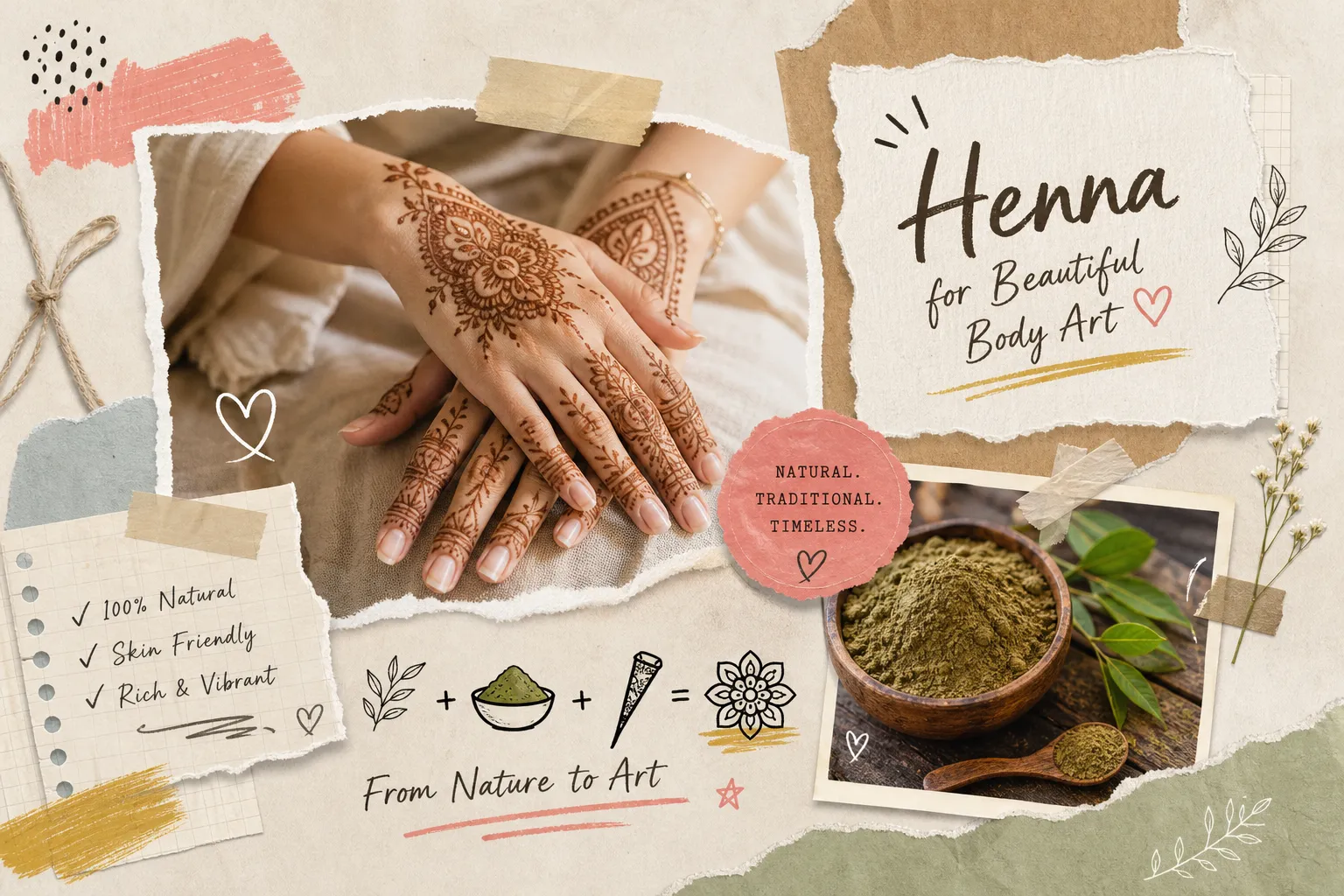
Henna powder for body art rests on three non-negotiables: verified high lawsone content, an ultra-fine sift grade of 100-mesh or cloth-filtered, and a clean Lawsonia inermis ingredient list with zero additives. A powder that meets all three will release dye reliably, flow smoothly through a cone tip, and leave a deep reddish-brown stain that lasts 10 to 14 days. The recipe, the cone technique, and the aftercare all build on getting that base powder right. This guide walks you through every step, from identifying genuine body-art mehndi powder to locking in the darkest stain possible.
Most people end up with weak, patchy stains or, worse, chemical reactions because they start with the wrong powder. A marketplace listing that says “organic” or “natural” is not evidence of quality. Knowing what to look for, and what to refuse outright, is what separates a stunning result from a frustrating one. By the end of this guide, you will know exactly what to buy, how to prepare it, and how to protect your work once it is on the skin.
Key takeaways
- Lawsone content matters most: Look for 2.5 to 3.0% or higher on a batch Certificate of Analysis from independent HPLC testing.
- Sojat origin is the benchmark: GI-certified Rajasthani henna ties your powder to a specific, high-yield agricultural region, not just a packaging location.
- Black henna is dangerous: It typically contains PPD, a synthetic dye that causes chemical burns and lifelong sensitisation. Natural henna never stains jet-black.
- Paste consistency is critical: Mix to a thick yogurt or mashed-potato texture and rest for 8 to 12 hours before testing for dye release.
- Aftercare drives longevity: Keeping the stain dry for 24 hours after paste removal contributes more to stain depth than any additive in your recipe.
- Sensory checks are a first filter only: Pure powder is muted green and smells grassy, but appearance alone cannot detect PPD or heavy metals.
What makes henna powder for body art truly body-art quality?
The lawsone percentage that separates strong stains from weak ones
Lawsone is the dye molecule found naturally in Lawsonia inermis leaves, and its concentration in the dried powder is the single biggest factor in how dark and long-lasting your stain will be. Ordinary dried henna leaves contain roughly 0.5 to 2% lawsone, but body-art-grade powder should show 2.5 to 3.0% or higher on a batch-specific Certificate of Analysis from independent HPLC testing. Commercial blends formulated for volume rather than dye strength frequently fall below this threshold, producing the pale, orange-tinged results that disappoint first-time users.
When you are evaluating any supplier, ask for that COA directly. A batch number, certifying laboratory name, and a lawsone figure verified by HPLC are the markers of a supplier who takes quality seriously. A vague claim of “high lawsone” on a product listing is not a substitute for documented evidence.
Why Sojat, Rajasthan is the benchmark origin
Sojat, a town in Rajasthan’s Pali district, holds a Geographical Indication (GI) registration that formally recognises it as India’s premier henna-producing region. The local soil composition, climate, and traditional cultivation practices combine to give Sojat-grown leaves a dye potency that other growing regions rarely match. GI certification adds a layer of traceability: it ties the powder to its agricultural origin rather than simply to wherever it was packaged or exported from.
At Narti Herbs, the GI-certified Sojat Rajasthani henna is exactly this kind of origin-verified powder. It is body-art quality, available in bulk sizing that suits both regular practitioners and professional mehndi artists, and sourced to the same traceable standards that serious body-art work demands. When you buy GI-certified Sojat henna, you are buying geographic accountability alongside dye potency.
Mesh grade and sieve quality: what 100-mesh means for your paste
A 100-mesh powder has passed through a screen with 100 openings per linear inch, making it fine enough to flow through a cone tip without frequent clogging. Triple-sifted and cloth-filtered are common descriptors but are less standardised: triple-sifting describes a process, not a guaranteed particle size, and some suppliers use it to produce powder that is finer than a nominal 100-mesh batch. Cloth-filtered powder typically offers the silkiest paste and the best flow through narrow tips, particularly for detailed mehndi designs.
For everyday cones, 100-mesh is usually adequate. For fine-tip work or intricate bridal designs, a triple-sifted or well cloth-filtered powder reduces the grit, backpressure, and sputtering that interrupt a clean line. The most reliable test is a practical one: mix the powder, allow it to hydrate, and check whether it moves smoothly through your intended tip with consistent pressure.
How to spot fake henna powder for body art before buying
Black henna is not henna: the PPD risk
“Black henna” products used in tourist markets and some local stalls typically contain para-phenylenediamine (PPD), a synthetic dye with no connection to the Lawsonia inermis plant. PPD can cause severe allergic reactions, chemical burns, blistering, and lifelong sensitisation to certain hair dyes and related chemicals. Reactions often appear four to ten days after application, and some people react as late as three weeks later.
Natural henna does not produce a black stain on skin. Ever. Any product promising a jet-black temporary tattoo should be refused immediately. Pure Lawsonia inermis stains orange immediately after paste removal and oxidises to a reddish-brown over the following 48 hours. That colour range is not a flaw; it is the proof that you are working with the real thing.
Reading the ingredient list and verifying the COA
Pure henna paste for tattoos and body decoration has one ingredient: Lawsonia inermis leaf powder. Named herbal blends that include indigo or amla are acceptable when clearly labelled, but terms such as “compound henna,” “colour,” or “herbal chemicals” are warning signs that something else is present. Always request a batch-specific COA that includes lawsone content, PPD-negative test results, absence of metallic salts, and a microbial safety check.
An organic certification is only meaningful when you can verify the certificate number, the certifier’s name, the scope of certification, and the validity dates tied to the specific lot you are purchasing. A marketplace listing that simply reads “organic” does not prove anything. Traceable documentation does.
What genuine henna powder looks, smells, and feels like at home
Pure henna powder is muted green, olive, or khaki in colour with a grassy or hay-like smell. A neon green colour, a chemical or ammonia odour, or an unexplained dark powder are signals of adulteration worth taking seriously. A quick sensory check is a useful first filter when a parcel arrives, but it cannot detect PPD, heavy metals, or synthetic dyes at trace levels. Laboratory testing is the only reliable safety confirmation for any product you are applying to skin.
What is the best henna paste recipe for a deep, long-lasting stain?
Ingredients and proportions to mix per 100g henna powder
Start with 100g of henna powder for body art applications. Add 150 to 200ml of lemon juice or cooled strong black tea gradually, mixing as you go to control consistency. Add one to two tablespoons of sugar and one to two teaspoons of a skin-safe, terpene-rich essential oil such as lavender or tea tree. The acid in lemon juice helps lawsone release from the powder; sugar improves paste contact with the skin; the essential oil assists dye penetration into the outer skin layer.
Mix until you reach a thick yogurt or mashed-potato consistency. Avoid adding all the liquid at once; a paste that is too thin will bleed outside design lines and give an uneven stain. Cover the surface of the paste directly with plastic wrap to prevent a crust forming.
Resting the paste and the dye-release test
Leave the covered paste in a warm, dark place for 8 to 12 hours at roughly 22°C. Cooler conditions may require up to 24 hours. Do not rush this step: the resting period is when lawsone molecules migrate to the surface of the paste and become available to bond with keratin in the outer skin layer. Skipping or shortening it is the single most common reason a well-sourced powder delivers a disappointing stain.
To confirm readiness, smear a small amount on the inside of your wrist, wait a few minutes, then wipe it off cleanly. A clear pumpkin-orange mark means the paste is ready. A pale or colourless mark means it needs more time. This test costs nothing and prevents the disappointment of applying an under-developed paste to a full design.
Which additives genuinely help and which to avoid
Lemon juice works as the acidic mixing liquid but should be diluted: roughly one part lemon juice to one or two parts cooled strong tea rather than using it undiluted, as neat lemon can irritate sensitive skin. Essential oils such as eucalyptus or tea tree can deepen the stain, but use them sparingly, no more than one to two drops per 25g of powder. Lemon essential oil carries a phototoxic risk and should be avoided on skin entirely.
The most important detail about additives is this: aftercare contributes more to stain longevity than increasing your acid or oil levels. A well-sourced powder, a correctly rested paste, and disciplined aftercare will outperform any heavily fortified recipe built on a lower-quality base.
How do you fill a henna cone and apply it for clean, precise designs?
Getting the paste to the right cone-filling consistency
Paste for cone work should be slightly thicker than for direct brush application, closer to stiff mashed potato than a fluid drizzle. A paste that is too thin will pool and bleed outside design lines. One that is too stiff will be difficult to squeeze evenly and may crack on the skin before dye has fully released. Do a quick squeeze test on the back of your hand before filling the cone to confirm the consistency is right. Mehndi cone powder blends for fine-tip cones benefit especially from this check, since narrow openings leave almost no margin for a paste that is slightly off.
Filling and sealing the cone step by step
- Rest the empty cone tip-down in a glass and fold the open edges over the rim to hold it steady.
- Place a transfer bag or piping bag deep into the cone and squeeze paste toward the tip first to eliminate air pockets.
- Continue filling slowly, stopping when the cone is no more than two-thirds full. Leave room to fold and seal the wide end properly.
- Tap the cone lightly and press from the wide end toward the tip so the paste settles and any trapped bubbles rise out.
- Press the open end flat, fold both upper corners inward to form a triangular flap, then fold that flap downward once or twice.
- Secure the fold with transparent tape; add a rubber band for extra support if needed.
- Snip only a tiny amount from the tip at a slight angle. Test on paper first and enlarge the opening gradually until the line width suits your design.
Application tips for deep skin contact and a rich stain
Apply the paste thickly rather than in fine hairline deposits. Henna releases dye through direct, sustained contact with the skin, so a generous layer consistently outperforms a thin one. Allow the paste to dry on the surface for 15 to 30 minutes, then dab a lemon-sugar sealant, equal parts lemon juice and sugar, slightly warmed, over the design to keep it supple and prevent premature flaking.
Leave the paste on for a minimum of 4 to 6 hours. Overnight application of 6 to 8 hours gives the richest results, particularly on wrists and the tops of the feet where skin is thinner. On palms and soles, where the skin is thickest, the same overnight contact time produces the deepest stains of all.
What aftercare routine gives the darkest and longest-lasting mehndi stain?
The first 24 hours after paste removal: what to do and what to avoid
Scrape the dried paste off gently with a blunt edge; do not wash it off with water. Water at this stage interrupts the oxidation process through which the stain continues to deepen in the outer skin layer. Keep the stained area completely dry for at least 8 to 12 hours after removal, and ideally for a full 24 hours. Avoid hand sanitiser, soap, and any scrubbing in the design area.
The stain will appear orange immediately after paste removal. Over the following 24 to 48 hours it oxidises to a rich reddish-brown. This deepening is natural and expected; resist the urge to judge the result in the first hour.
Moisturising, protecting, and extending the stain
Once the initial dry period is complete, apply a thin layer of natural oil such as coconut or olive oil over the design. The oil creates a barrier that slows the exfoliation of dyed skin cells and keeps the colour looking rich for longer. Avoid prolonged soaking in water, chlorinated swimming pools, harsh soaps, and any exfoliation on the design area. On palms and fingers, where skin is thicker, a well-applied stain from a high-lawsone powder typically lasts 10 to 14 days. On thinner skin areas such as wrists or the tops of feet, expect 5 to 10 days.
Common aftercare mistakes that fade mehndi too fast
The most frequent errors are washing the paste off with water, applying moisturiser before the dry period is complete, using alcohol-based hand sanitiser on a fresh stain, and exposing the design to chlorinated water in the first few days. Each of these strips away the dye before it has fully bonded and oxidised. Avoiding them costs nothing and makes a measurable difference to how long your design stays sharp and deep.
Your body art starts and ends with the right henna powder
No technique or recipe compensates for a poor-quality powder. The path to a rich, long-lasting stain begins with choosing the right henna powder for body art: high lawsone content, named Sojat or Rajasthan origin, finely sifted, and completely free from PPD and synthetic additives. That foundation is what makes everything else in this guide work.
Narti Herbs’ GI-certified Sojat henna powder is built precisely to these standards. It combines traceable Rajasthani origin with the lawsone potency that body-art work demands, and it is available in bulk sizing suited to both home practitioners and professional mehndi artists. If you are serious about the quality of your stain, the quality of your powder is where that commitment begins. Explore the Narti Herbs henna range and find the size and format that fits your practice.
One safety reminder to carry with you: never use anything labelled “black henna” on skin, regardless of where it is sold or how it is marketed. If you want consistently deep, reliable results, choose henna powder for body art with verified lawsone content and traceable Sojat origin. Natural henna stains orange to reddish-brown. That colour is the proof you are working with something genuine and safe.
Frequently Asked Questions
Can I use henna blends that contain indigo or amla for body art?
Yes, I accept named herbal blends that include indigo or amla when they are clearly labelled. I state that such blends are acceptable provided the ingredient list is transparent; avoid any product described as a vague “compound henna” or containing unspecified “colour” or “herbal chemicals.”
Is an “organic” label enough proof that a henna powder is safe and high quality?
No, an “organic” label alone is not sufficient proof of quality or safety. I advise you to verify the certificate number, the certifier’s name, the scope and validity dates tied to the specific lot, because a marketplace listing that simply reads “organic” does not prove anything.
How should I verify a batch Certificate of Analysis (COA) before buying henna powder?
Ask for a batch-specific COA that includes a lawsone percentage verified by independent HPLC, the certifying laboratory’s name, and a batch number. I also expect the COA to state PPD-negative results, absence of metallic salts, and a microbial safety check for full confidence.
Can I rely on sight and smell alone to confirm that henna powder is genuine and safe?
No, sensory checks are only a first filter and cannot detect PPD or heavy metals at trace levels. I recommend using muted green colour and a grassy smell as an initial check, but laboratory testing is the only reliable safety confirmation for any product applied to skin.
How long will a well-applied henna stain last on different parts of the body?
A high-lawsone stain on palms and fingers typically lasts 10 to 14 days, while thinner skin areas such as wrists or tops of the feet usually last 5 to 10 days. I note that aftercare, keeping the stain dry for the first 24 hours and applying oil afterwards, plays a major role in achieving those durations.